Utilities at Lake Chapala: Electricity, Water, Gas, Internet, Trash, and Who Actually Bills You
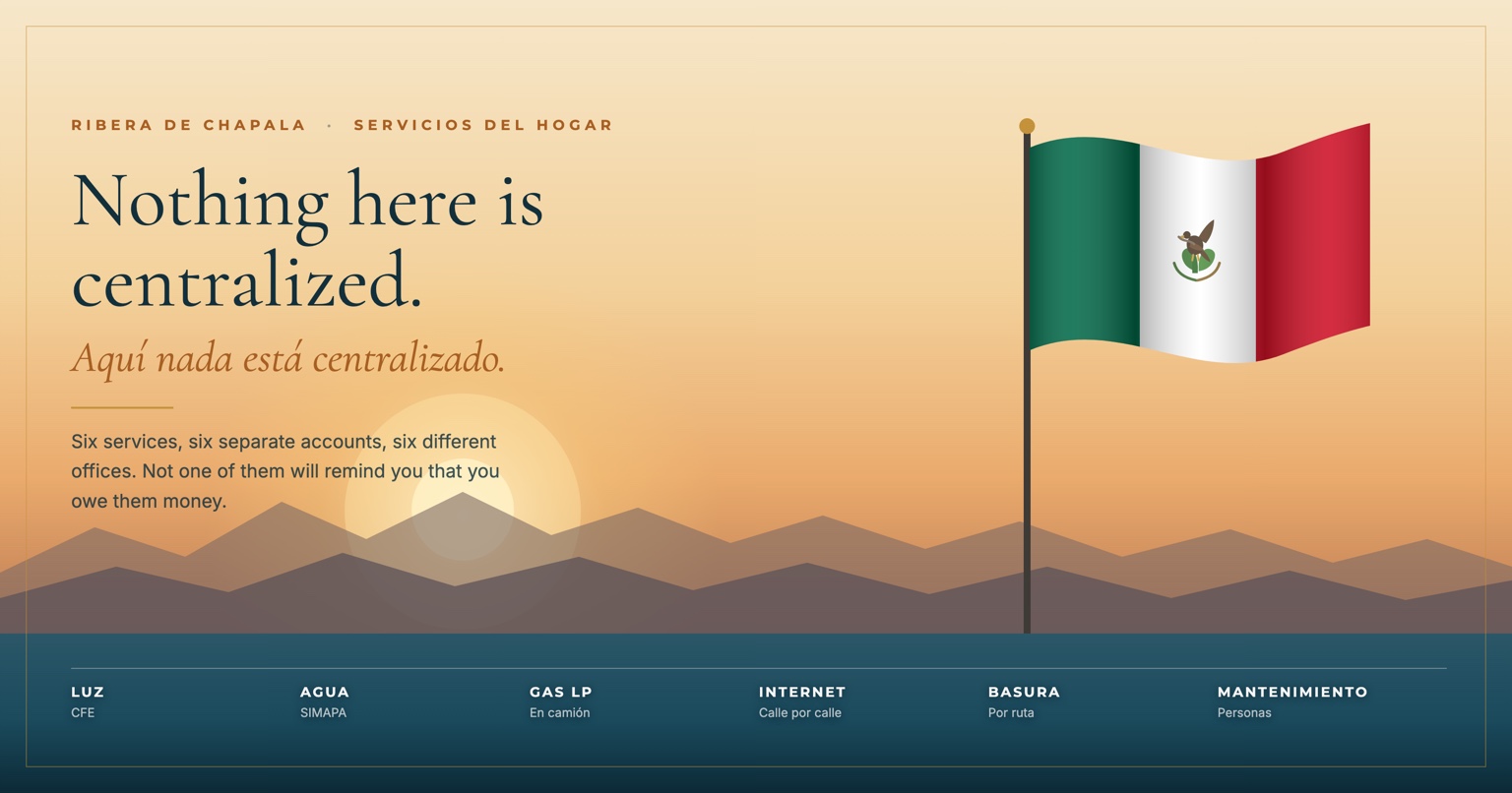
The bills are not what surprises people. Almost everyone who moves here from the United States or Canada finds them lower than what they left behind. What surprises people is that “the utilities” is not a thing at Lake Chapala. There are six unrelated systems, each with its own office, its own billing rhythm and its own opinion about how you are supposed to pay it, and not one of them is going to remind you.
I have handed over the keys to a lot of houses on this shore, and the pattern hardly varies. The first month is easy, because the previous owner's arrangements are still running on their own momentum. Around month three someone calls me because the water stopped, or the gas ran out mid-shower, or a CFE bill arrived for four times what they were expecting. None of it is a disaster. All of it is avoidable if somebody explains the pieces before you move in, so that is what this is.
The short version
- Electricity comes from CFE, the federal utility, and is billed every two months.
- Water comes from your municipality, is billed once a year in a single payment, and does not arrive under pressure the way it does back home.
- Gas is LP, not natural gas, and it arrives on a truck. You pay the driver in cash.
- Internet is competitive and mostly good, but whether it reaches your particular house is a street-level question, not a town-level one.
- Trash is municipal and runs on a route with a time, not on a weekly calendar with a bin at the curb.
- Maintenance is the one nobody counts as a utility, and it is the one made entirely of relationships with individual people.
Property tax belongs on the same trip as the water bill, so it gets a section here too.
Electricity, and the tariff that quietly doubles your bill
CFE is the only electricity supplier, residential service is billed bimonthly, and the single most useful thing I can tell you about your bill is printed on the front of it: your tariff. It will read 1, or 1A, or 1B, and so on up the alphabet, and that letter sets the amount of power you are allowed to use at the subsidised price.
Go over that allowance and CFE moves you to DAC, the high-consumption domestic tariff. DAC is not a penalty on one bad month. CFE looks at your rolling twelve-month average, and once that average crosses the line the subsidy comes off entirely: you pay a fixed monthly charge plus an unsubsidised rate per kilowatt hour, which in 2026 has been running in the neighbourhood of six to seven pesos. Getting back out takes another rolling year of lower consumption. People describe DAC as their bill doubling. For heavy users it is worse than that.
Here is the part specific to this lake. Our climate is mild, which is why most of us moved here, and a mild climate means Lakeside homes generally sit on one of the lower tariffs with a correspondingly low threshold. Nobody here is running air conditioning through a coastal summer, so nobody here gets a coastal summer allowance either. The things that actually push my clients into DAC are:
- A pool pump left running too many hours a day. This is the most common single cause I see, and it is usually fixable with a timer.
- An electric water heater in a house where everyone else on the street heats water with gas.
- A casita, a guest apartment or a rental unit sharing the main meter. Two households of consumption get measured as one, and the threshold does not care that there are two of you.
- Space heaters in January. This one catches everybody. People move to Mexico and never imagine being cold, then discover that houses here have no insulation, no central heat and tile floors, and that January mornings at this altitude are genuinely chilly. A month of electric heaters will show up on the bill.
Two practical notes. The account and any unpaid balance follow the meter, not the person, so a debt left by a previous occupant becomes your problem the day you take the house. Always ask to see recent bills, and always ask whether the balance is clear. And you can pay through the CFE app, at OXXO, at your bank, or in person at the CFE office in Chapala, but you do need the service number off the bill to do any of it, which is a good reason to keep one.
Water arrives on a schedule, and your house is the storage tank
This is the system that confuses newcomers most, because it does not resemble what they are used to at all. In Chapala municipality your water comes from SIMAPA, the municipal water and sewer system. What SIMAPA does is release water into the neighbourhood network, for a certain number of hours, on certain days. Depending on where you live that might be most days, or it might be two or three times a week.
Your house catches it. Almost every home on this shore has an aljibe, an underground cistern that fills when the water is running. From there a pump or a pressurised tank called a hidroneumático pushes water up to a tinaco, the black tank you see on rooftops all over Mexico, and gravity or the pump gives you pressure at the tap. That is the whole system, and once you can see it, a lot of odd things start making sense.
- A power cut can stop your water even with a full cistern, if your pressure depends on a pump. Houses that run on gravity from the tinaco keep working.
- You can run out. If the aljibe empties, you call a pipa, a water truck, and pay somewhere in the range of 700 to 800 pesos to have it filled. It is a phone call rather than an emergency, though not one you want to make on a Sunday.
- Both tanks need cleaning, once a year, with bleach, by someone who does this for a living. Water that has been sitting in a cistern or baking in a rooftop tank is not the same water that went in.
- Leaving for the summer is a decision, not a default. Somebody needs to be responsible for the pump, the tanks and the bill while you are gone.
Billing works nothing like a metered North American water bill. It is an annual charge for the connection, paid once, at a SIMAPA window. In Chapala municipality the offices have long been at Calle Juárez 573 in Chapala, Guadalupe Victoria 63 in Ajijic and on the carretera in San Antonio Tlayacapan, open weekday mornings until mid-afternoon. Payment opens in early January.
Pay in January. Chapala gives roughly 15 percent off the annual water and property tax bills for early payment, with a smaller discount as the weeks go by and nothing at all by late spring. The exact percentages are voted fresh into the municipal revenue law every year, so treat the numbers as roughly right and confirm at the window. The advice never changes: go in January, and do the water and the property tax in the same trip.
One more thing worth knowing: the discount for seniors on the water bill has been applied to Mexican citizens only, which catches foreign retirees who assumed they qualified. Ask at the window rather than assuming either way.
You do not drink it
Nobody drinks from the tap here. Not the foreigners, not the Mexican families who have lived on this shore for generations. Drinking water comes in garrafones, the twenty-litre jugs you see everywhere, delivered to the door or bought at any corner shop for a couple of dollars a refill. That is the normal answer and for most households it is a fine one.
It is worth knowing why people here take it seriously, though. A study published in late 2020, sampling three communities in the Lake Chapala basin in 2019, found detectable arsenic in 61.9 percent of tap water samples and, more soberingly, in 32 percent of garrafón samples. The towns sampled were San Pedro Itzicán and Mezcala in Poncitlán municipality and Chapala itself, so this is not a study of Ajijic and it is not a reason to panic. It is the reason the water people on this shore fit reverse osmosis at the kitchen sink as a matter of course rather than as an upgrade, and it is a good argument for either buying your jugs from a brand you can name or filtering at home.
Gas comes on a truck
There is no piped natural gas at Lakeside. Everything runs on LP gas, and it reaches your house one of two ways: cylinders that get swapped out, or a tanque estacionario, a fixed tank that a truck fills.
The price is not a negotiation. Mexico's energy regulator sets a maximum price by region and updates it weekly, and in early September 2026 the ceiling in Jalisco was averaging around 19.50 pesos per kilogram and 10.55 pesos per litre. To make that concrete: a 300-litre stationary tank is filled to about 80 percent for safety, so a fill is roughly 240 litres, and roughly 2,500 pesos. Bring cash. The driver is not going to take a card.
Gas heats your water and usually cooks your food, and the practical consequence is the one every household here learns the same way. It runs out in the shower. It runs out on a Sunday. Get in the habit of glancing at the gauge on the tank the way you glance at the fuel gauge in a car, and call before you are empty rather than after. Several distributors work the carretera and any of them will come, but which one is reliable this year is genuinely local knowledge. Ask the neighbours on your street, not the internet.
Internet is a street-by-street question
The good news first: this is a much better place to work remotely than it was five years ago. Telmex has fibre through a lot of the corridor, Totalplay and the cable operators compete hard on price, ILOX built fibre specifically for this lakeshore and has an office and a local number in the area, and Starlink covers the houses up the hillsides and out past the towns where nothing else reaches.
The catch is that coverage does not follow town boundaries. It follows infrastructure, which means the house you are looking at may have fibre while the one across the street does not, and a village that everyone describes as “fine for internet” can have pockets where it is not. So do not take a seller's or a landlord's word for it. Ask which provider serves that specific address, ask to run a real speed test while you are standing in the house, and ask the neighbours what they use.
Two habits worth copying from people who work here. Put the router on a small battery backup, because a power flicker that lasts thirty seconds should not cost you a video call. And if your income depends on being online, run two connections from two different providers. Among the people here whose living depends on being reachable, running two is simply what is done.
Trash runs on a route, not on a calendar
Collection is municipal and it is frequent, which surprises people. In central Ajijic the truck has historically worked mornings, starting around seven and finishing by mid-morning, and outlying neighbourhoods get their own days. Garden and green waste is collected separately on separate days, and there is a recycling centre out on the carretera.
The etiquette matters more than the schedule. You do not put a bin at the curb the night before, because street dogs will open it and then it is your rubbish spread down the block and your neighbours know exactly whose it was. You bring it out in the morning, close to when the truck comes, or you hand it to the crew directly. Tipping that crew is customary here, and an aguinaldo at Christmas is close to universal. Ask a neighbour what your street does, because the going rate is a street-level convention and getting it right costs almost nothing.
Routes and times do get reworked by the municipality, so the reliable source is not a website. It is the person next door.
Maintenance is the sixth utility, and it is made of people
At home you call a company. Here you have a gardener, a person who cleans, someone for the pool, a plumber, an electrician, and eventually the one person who actually understands your particular pump. Most of them come on a schedule rather than on call, the cost is modest and predictable, and the quality of your life here depends on this list far more than on any of the five systems above.
Which leads to the most underrated thing you can inherit with a house: the previous owner's people. Ask for the list explicitly and ask for introductions. Those names are worth more than the appliances, and a seller who has lived here a while will usually be glad to hand them over.
If you buy in a gated development or a fraccionamiento, there is also a monthly or annual cuota covering gates, security, common areas, street upkeep and sometimes a shared water arrangement. Ask what it is, ask what it covers, and ask whether the seller is current on it, before you sign anything.
Property tax, once a year, and it rewards you for being early
The predial is Chapala's annual property tax and payment opens in the first days of January. The municipality has been giving 15 percent off bills paid in full during January and February, dropping to 5 percent in March and April. Seniors, pensioners, retirees and people with disabilities can qualify for up to 50 percent, though the reduction applies only up to a ceiling on the property's assessed value, which in recent years has been 1.5 million pesos of tax value.
You pay at the Catastro counter and the cashier windows on the ground floor of City Hall in Chapala, weekday mornings and Saturday mornings, and they will want last year's receipt or the owner's identification. Cash, card and transfer all work. As with the water bill, the percentages are set anew every year, so confirm the current ones rather than quoting mine back at the cashier.
By North American standards the amount itself is small enough that people ask me twice whether they have understood it correctly. They usually have.
Which municipality you are in changes four of these
The lakeshore reads as one continuous corridor when you drive it, and it is not. Chapala municipality covers Chapala, Santa Cruz de la Soledad, San Nicolás de Ibarra, Riberas del Pilar, San Antonio Tlayacapan and Ajijic. Keep driving west and you cross into Jocotepec municipality, which covers San Juan Cosalá, El Chante and Jocotepec itself.
Cross that line and your water utility changes, your property tax office changes, your trash route changes and your building permits change. Electricity and gas do not, because CFE is federal and gas distributors are private. It is one of the least-discussed practical differences between towns on this shore, and it is a perfectly fair thing to ask about before you fall in love with a particular house. My community-by-community guide to the corridor walks the towns in order if you are still working out where you want to be.
What I check on a house before a client signs
This is the part I can do that a checklist on the internet cannot, because it happens inside the actual house. When I walk a property with a buyer or a long-term renter, this is what I am looking at:
- The CFE bill. Whose name is on it, which tariff it shows, what the last several periods actually consumed, and whether there is an unpaid balance. The debt follows the meter.
- How many meters there are, and what is on each. A casita quietly sharing the main meter is the fastest route into a high-consumption tariff.
- The aljibe. Whether there is one, how big it is, whether the lid seals properly, and when it was last cleaned.
- How the house makes pressure. Gravity from the tinaco, a pump, or a hidroneumático, and specifically what happens to the water when the power goes out.
- Which days that street actually receives water. From the neighbours, not from the seller.
- Whether there is filtration, what kind, and when the media was last changed.
- Cylinders or a stationary tank, and if it is a tank, who owns it. Some tanks belong to the distributor rather than to the house.
- Which internet reaches that address, confirmed with a speed test run while we are standing there.
- Current SIMAPA and predial receipts.
- The cuota, if there is one, and exactly what it covers.
- The list of people. Gardener, pool, cleaner, plumber, and whoever knows this particular pump.
If you are looking at a specific house, ask me to run this on it. It takes one visit and it is part of what I do for the people I work with. It is also the single cheapest way to find out that the charming casita out back has been on the main meter for six years.
So what does a month actually cost?
I am not going to hand you one number, because the honest answer is that the range on this shore is enormous and almost none of it depends on the town. Two houses four doors apart can differ by a factor of three, and the difference is never the address. It is the pool pump, the electric water heater, the casita on the meter, the size of the aljibe and whether anyone has ever put a timer on anything.
What I can tell you is the shape. Water is annual and small enough to be a rounding error. Trash is municipal plus a tip. Internet costs about what you are paying now and often less. Property tax will make you laugh the first time. Gas is the real variable, because it heats your water, and electricity is the one that can genuinely hurt you, but only if the house has one of the handful of features listed above and nobody warned you. That is exactly why I go through the list before anyone signs.
A note on the numbers in this article
Everything here was checked in September 2026. Gas prices are repriced weekly by the regulator. CFE tariffs update on their own schedule and the DAC threshold is a rolling twelve-month average, not a fixed line. Chapala's discounts and rates are voted fresh into the municipal revenue law each year, and office hours and addresses do move. Treat all of it as how the system behaves rather than as a quote, and confirm at the window. I am a real estate agent, not a plumber, an electrician or an accountant.
One last thing
None of this is difficult. It is only unfamiliar, and unfamiliar has a way of making intelligent people feel like they are failing at something everybody else already understands. You are not. Every foreigner on this shore learned it the same way, one surprise at a time, and most of us would have paid good money for a list like this one before we started.
If you are looking at a house and want to know what you would actually be taking on, please write to me or send a WhatsApp. If you are earlier than that, my guides to health care and where to buy groceries cover the rest of the practical week, and renting before you buy is still the advice I give almost everyone. Partly for the reason this article exists: a rental teaches you all six of these systems on somebody else's account. When you are ready, my rentals and listings are always current.
Sol Ramirez is a bilingual real estate agent and Rental Manager at Lago Montaña Real Estate in Ajijic. She holds a Diplomado en Derecho Inmobiliario from CEFOR / Cámara de Comercio Guadalajara and has worked in the Lake Chapala region since 2019, covering sales and long-term rentals across the full Lakeside corridor.
Frequently Asked Questions
Are utilities expensive at Lake Chapala?
Generally no, and most people who move here from the United States or Canada find their total monthly outlay lower than what they left. The important caveat is that the range between houses is very wide, and it is driven by the property rather than the town: a pool pump, an electric water heater or a guest casita sharing the main electricity meter can multiply an electricity bill several times over. Water and property tax are annual and small. Gas is the biggest ordinary variable, because it heats your water.
How often does CFE bill, and what is the DAC tariff?
Residential electricity is billed every two months. Your tariff is printed on the front of the bill and sets how much power you can use at the subsidised rate. If your rolling twelve-month average consumption crosses that threshold, CFE reclassifies you to DAC, the high-consumption domestic tariff, which removes the subsidy entirely and adds a fixed charge. In 2026 the unsubsidised rate has been running around six to seven pesos per kilowatt hour. Getting back off DAC requires another rolling year of lower consumption, so it is much easier to avoid than to reverse.
Why did my electricity bill at Lake Chapala suddenly triple?
The usual answer is that you were moved to the DAC tariff. The four causes I see most often on this shore are a pool pump running too many hours a day, an electric water heater in a house where the neighbours all use gas, a casita or rental unit sharing the main meter, and a month of electric space heaters in January. Houses here have no insulation and no central heat, so winter mornings catch people out. A timer on the pool pump is often the entire fix.
Is the tap water safe to drink in Ajijic and Chapala?
No, and nobody here drinks it, including families who have lived on this shore for generations. Drinking water comes in twenty-litre garrafones, delivered or bought locally for a couple of dollars a refill. A study published in 2020, sampling San Pedro Itzicán, Mezcala and Chapala in 2019, found detectable arsenic in 61.9 percent of tap samples and 32 percent of garrafón samples, which is why many households here also fit reverse osmosis at the kitchen sink and why it is worth buying jugs from a brand you can identify.
What is an aljibe and a tinaco, and do I need both?
Water is not delivered under constant pressure here. The municipality releases it into the network for a set number of hours on set days, so your house has to store it. The aljibe is the underground cistern that fills when the water is running; the tinaco is the rooftop tank that supplies the taps. Between them sits a pump or a pressurised hidroneumático. Most houses on this shore have all three, and if yours relies on a pump for pressure, a power cut will stop your water even with a full cistern.
What happens if my cistern runs dry?
You call a pipa, a water truck, which comes and fills the aljibe for somewhere in the range of 700 to 800 pesos. It is a routine phone call rather than an emergency, but it is worth knowing the number before you need it, and worth knowing which days your street actually receives water so it does not happen often.
How do I get gas for my house in Ajijic?
There is no piped natural gas at Lakeside. Homes run on LP gas delivered either as swappable cylinders or as a truck fill into a fixed stationary tank. Mexico's energy regulator caps the price by region and updates it weekly; in early September 2026 the Jalisco ceiling was averaging about 19.50 pesos per kilogram and 10.55 pesos per litre, which puts a fill of a 300-litre tank at roughly 2,500 pesos. Pay the driver in cash, and check the gauge before you run out rather than after.
Is the internet good enough to work remotely from Lake Chapala?
For most people yes. Telmex fibre covers much of the corridor, Totalplay and the cable operators compete on price, ILOX built fibre specifically for this lakeshore, and Starlink reaches the houses that nothing else does. The thing to understand is that coverage is street-level rather than town-level, so confirm the specific address before you commit. People whose income depends on being online tend to run two providers and keep the router on a battery backup.
When should I pay my property tax and water bill in Chapala?
January, and do both in the same trip. Chapala opens payment in the first days of the year and has been giving around 15 percent off bills paid in full in January and February, falling to about 5 percent in March and April. Seniors, pensioners, retirees and people with disabilities can qualify for a larger reduction on the property tax, capped at a ceiling on assessed value. The exact percentages are set fresh each year, so confirm them at the window rather than assuming last year's figures.
Do I inherit the previous owner's unpaid utility bills?
With electricity, effectively yes. The CFE account and its balance follow the meter rather than the person, so an unpaid balance becomes your problem the day you take the house. The same logic applies to outstanding water charges and property tax on a purchase. Always ask to see recent bills and current receipts before you sign, which is one of the standard checks I run on any property before a client commits to it.
Does it matter which municipality my house is in?
More than most people expect. Chapala municipality covers Chapala, Santa Cruz de la Soledad, San Nicolás de Ibarra, Riberas del Pilar, San Antonio Tlayacapan and Ajijic; keep driving west and San Juan Cosalá, El Chante and Jocotepec are in Jocotepec municipality. Crossing that line changes your water utility, your property tax office, your trash route and your building permits. Electricity and gas are unaffected, since CFE is federal and gas distributors are private.